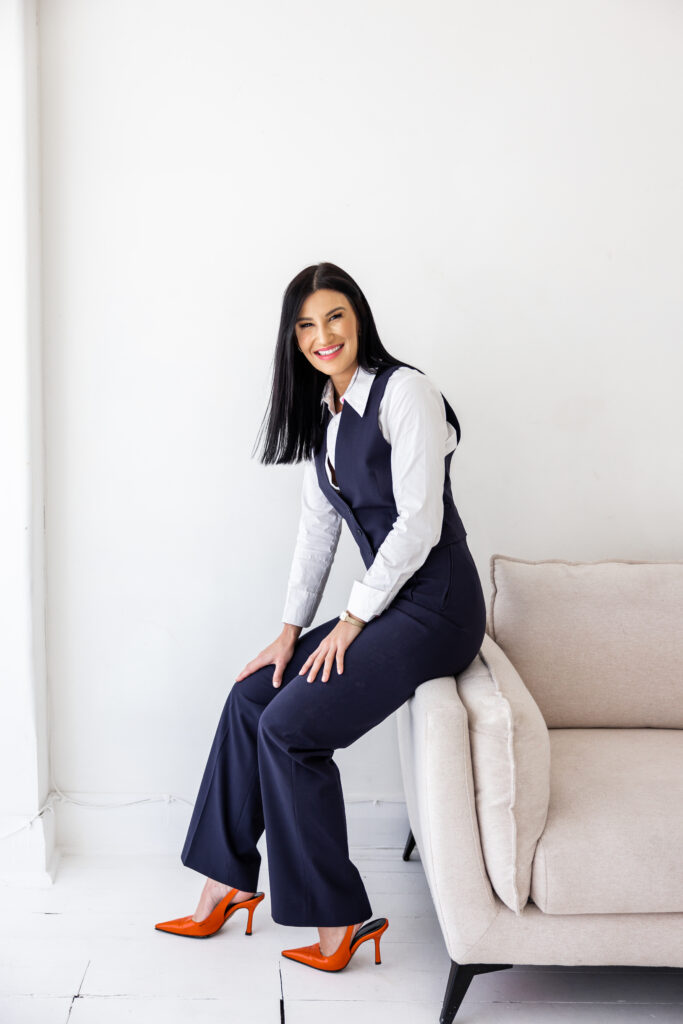
In industries where leadership has traditionally followed a predictable script, Maike Barton is quietly rewriting the rules. As the Founder and Managing Director of Your GM, she works with professional service firms to bring structure and clarity to growing organisations, but her influence extends beyond operational strategy. Through her work and perspective, Barton represents a new generation of women redefining what leadership, resilience, and success can look like.
You work in industries that have historically been male-dominated. What has it been like stepping into those spaces as a young female founder?
I started out in Law, and I recently came across a statistic that in Australia, women now make up around 60 to 65 percent of law graduates. On paper, it suggests the playing field has shifted. However, once you step into the workforce, the reality often tells a different story. Managerial and senior leadership positions are still, more often than not, held by our male counterparts.
I started my career in law, and from early on, I experienced the disconnect between progress on paper and reality in practice. I’ve had bosses throw books at me. I’ve been told to stop wearing pants and “dress more like a woman.” I’ve stood in boardrooms presenting to a group of men and had someone interrupt to say, “Maike, that’s a boy’s name.” My response was simple: “How do you know I’m not?”
You learn quickly in those environments. Not just how to do your job, but how to hold your ground.
What’s important is that I never let those moments define how I saw myself. I grew up with brothers and a strong father, so I’ve always understood that men aren’t the problem. People are people. But it does make you question why, in this day and age, those dynamics still exist. I think we are at a point in history, where there is a lot of pattern disruption where women don’t fit the historical pattern of what those environments expect, and people aren’t open to change.
I’ve made a very deliberate choice in my career: I don’t operate as “a female in business.” I operate as a business leader. I expect to be treated the same, and I hold myself to the same standard.
Where it does become more complex is around pregnancy. Not because of capability but because of perception. There’s an immediate assumption that you’ll step back, that you can’t perform, or that you won’t be available. The reality is very different. Many women are entirely capable of continuing to lead and deliver at a high level.
The challenge isn’t the work, it’s getting people to believe that.
For me, that comes down to structure, communication, and consistency. I’m clear on what I can deliver, I build the right support around me, and then I follow through. Because ultimately, you don’t shift perception by explaining it – you shift it by proving it.
Those experiences have shaped how I lead today. In my business respect is non-negotiable. We build businesses where people are valued for performance, not stereotypes, where the systems support people properly, so no one is underestimated or overlooked because of outdated thinking. I’ve seen the old rules. I’ve worked within them.
So like any contract I look at now, I can make a conscious decision to cross out what doesn’t serve me, before signing, refuse the fine print, decline the conditions or start rewriting the rules; and not to accept things the way they are simply because it’s easier.
Was there a moment where you realised the traditional leadership path wasn’t the one you wanted to follow?
Yes, there were definitely moments.
Early in my career, I found myself in situations where I could see opportunities, improvements, or different ways of doing things but I wasn’t in a position to act on them. Not because the ideas weren’t valid, but because of hierarchy, timing, or differing risk appetites.
I’ve always been very ambitious. From a young age, I set myself the goal of building real financial success early. I wanted to be a millionaire by the time I was 25. That mindset meant I was constantly looking for growth, efficiency, and better ways to operate.
Over time, I realised that the traditional leadership path, waiting your turn, progressing incrementally, and working within fixed structures, wasn’t fully aligned with how I think or operate.
I wanted to be in a position where I could not only see the opportunities, but actually execute them. Where I could build teams, implement strategy, and drive outcomes at pace. Where I could take every opportunity that came my way.
I am not wired for patience, I’ve always been ambitious, but not in a ‘title-chasing’ way. I’ve just always wanted to build things that actually work.
What stereotypes about women in leadership have you encountered and how have you challenged them?
One of the most common stereotypes I’ve encountered is that women in leadership are either too soft or, if they’re direct, too much.
I’ve always been quite clear, commercially focused, and outcome-driven, and at times that’s been perceived as being overly assertive. On the flip side, there’s also an assumption that as a woman, you’ll naturally take on a more supportive role in the room, rather than leading it. I’ve tried really hard not to engage with either.
I don’t overcorrect, and I don’t try to fit a particular mould. I focus on clarity, performance, and accountability, merit, facts. I’m direct when needed, but I’m also very people-focused because strong leadership requires both. Over time, that consistency shifts how you’re perceived. The conversation moves from “female leader” to simply “leader.”
There’s also a broader pattern I’ve observed, not just in my own experience, but across industries where women are often brought into leadership roles at the point where things are already challenging or in decline. They call this the ‘Glass Cliff’ with the expectation that it isn’t just to lead, but to fix, stabilise, and deliver under pressure from day one. This phenomenon is known as the ‘Glass Cliff,’ where the expectation is not merely to lead, but to immediately fix, stabilise, and deliver results under intense pressure. You see it in high-profile roles, and you see it in everyday business. The starting position is often different.
In some environments, there can be a scarcity mindset – where opportunities are perceived as limited, and rather than lifting others, people feel they need to protect their position. That can sometimes show up in a lack of support between women, particularly in competitive or high-pressure environments.
I’ve never subscribed to that. I believe if you lift others up with you, you will never be left behind.
For me, that reinforces the importance of structure and clarity. Whether it’s stepping into a role, leading a team, or navigating something like pregnancy where assumptions around capacity still exist the challenge is rarely capability. It’s perception and risk. So I focus on removing that ambiguity. I’m clear on expectations, I put the right structures in place, and then I deliver consistently. I also try to analytically review a potential opportunity once I’ve taken the rose coloured glasses off when it could be a loose loose situation.
If you can deliver, the narrative will follow.
Starting Your GM is a bold move. What pushed you to build something on your own terms rather than within a traditional corporate structure?
I was sitting in a bar and one of my very good friends asked a really simple question, ‘if you could do anything, what would you be doing?’
It made me think of where I was and what I was doing, and I realised that I had gotten to the top of where I could be at my 9-5 job. I had a pathway to partnership and a great boss but the question still lingered. I’d sit in rooms where the problems were obvious, the solutions were there, but the ability to actually execute was slowed down by layers, approvals, and competing priorities.
I stopped asking, “Why isn’t this being done?” and started thinking, “What would this look like if it was done properly?, Why can’t I do this?”
That answer became Your GM where I am rewriting the rules.
Do you think women are reshaping what leadership looks like today? What changes are you starting to see?
Yes but I don’t think it’s about women trying to lead differently. I think it’s about leadership finally evolving.
What we’re seeing now is a shift away from rigid, hierarchical leadership to something more balanced where commercial outcomes and people are given equal weight. And a lot of women naturally operate well in that space.
I often talk about this in terms of the “dinosaur vs octopus” leadership model.
The traditional model is the dinosaur: big, hierarchical, slow to move, and heavily reliant on command-and-control structures. It worked for a long time, but it’s not built for the pace and complexity of today’s environment.
What’s emerging now is more like the octopus: adaptive, intelligent, responsive, and able to operate across multiple areas at once. It’s less about control and more about coordination, awareness, and agility.
I’m also seeing less emphasis on titles and more on capability. The best leaders now aren’t the ones who command the room – they’re the ones who can align a team, make decisions quickly, and execute consistently.
For me personally, it’s never been about leading “as a woman.” It’s about leading effectively. But if that contributes to reshaping expectations of leadership, then that’s a positive outcome.
I think something I come back to consistently is that while bias and challenges absolutely exist, I’ve never chosen to build my identity around them. I’ve experienced those moments, but I’ve always focused on what I can control – how I show up, how I lead, and the results I deliver. For me, it’s not about ignoring the reality of those experiences, it’s about not letting them define how I operate. In business, perception shifts through performance, and I’ve found that clarity, consistency, and accountability are far more powerful than leaning into labels. It’s a mindset of ownership – acknowledging the environment, but not being limited by it.
The dinosaur had its time, but the future belongs to the octopus. I ignore any gender barriers and focus on building my way around them.
Have there been moments where choosing authenticity over fitting in felt risky in your career?
I am constantly feeling uncomfortable. Although I don’t think I’ve ever framed it as a single moment. It’s been a series of decisions over time where I’ve chosen to operate in a way that feels aligned with my goals, even when it wasn’t the easiest or most expected path.
There have definitely been situations where it would have been simpler to fit the mould – whether that was softening my communication, holding back on ideas, being goofy, having a personality or adjusting how I presented myself to be more “acceptable” in certain environments.
For me, authenticity isn’t about being different for the sake of it, it’s about feeling comfortable in your own skin and trying to block out the status quo.
But over time, being consistent becomes your strength. People know what to expect, they trust your intent, and you build a reputation that isn’t dependent on the room you’re in.
What advice would you give to young women entering industries where they may still be in the minority?
Don’t walk into a room thinking about whether you belong there – walk in knowing what you bring to it. Know that receptionists can broker million-dollar deals, that high-ranking directors once worked at your local fish and chip shop for minimum wage, and that although the people in those rooms may be very knowledgeable, they all laugh, they all bleed, and maybe they don’t even know the simple fun fact that a male rabbit is called a buck. Know, too, that you don’t have to have all the answers right away – you can choose to find them later.
If you focus on being “the only woman,” you make yourself smaller and alone. If you focus on being the most effective, the room suddenly expands.
Back yourself early. Speak before you feel ready, practice, make mistakes and fail quickly, learn and get back up to try again.
Ask all the questions you possibly can, even if they feel ammature and if the environment doesn’t recognise your value, don’t shrink to fit it. Outgrow it.
If more women rejected the traditional blueprint for career success, how do you think the business world might change?
I think the bigger question is what is the traditional blueprint?
Is it:
Time over impact: tenure matters more than results
Hierarchy over capability: title defines authority
Conformity over individuality: fitting in is rewarded
Permission over ownership: decisions sit at the top
Whether the traditional blueprint was ever the best model to begin with might be another question?
It rewards time over impact, hierarchy over capability, and consistency over innovation.
If more people, as a community, not just women, reject that and instead focus on building careers around performance, flexibility, and ownership we won’t just change career paths, you will change how the world of businesses operate.
I didn’t reject work: I rejected inefficiency
I didn’t reject leadership: I rejected slow, rigid systems
I didn’t reject structure: I am rewriting the rules and structure at Your GM
Read more of our Inspiring Profiles here.
Learn more about Maike Barton here.